
Abstract
Aims
Systemic inflammation is characteristic of polycystic ovary syndrome (PCOS), but its prognostic value for intrauterine insemination (IUI) outcomes remains unclear. We evaluated whether systemic inflammatory markers and metabolic parameters were associated with clinical pregnancy after the first IUI cycle following ovulation induction.
Methods
This retrospective cohort study included infertile women with PCOS undergoing their first IUI cycle after ovulation induction with an aromatase inhibitor between May 2021 and May 2026. Clinical pregnancy was defined as ultrasonographic visualization of a gestational sac with fetal cardiac activity. Demographic, clinical, hormonal, metabolic, and IUI cycle characteristics and systemic inflammatory markers—neutrophil-to-lymphocyte ratio (NLR), platelet-to-lymphocyte ratio (PLR), lymphocyte-to-monocyte ratio (LMR), systemic immune-inflammation index (SII), systemic inflammation response index (SIRI), and C-reactive protein (CRP)—were compared according to pregnancy status. Analyses were performed using Jamovi (version 2.6.45; the Jamovi project, Sydney, Australia).
Results
A total of 113 women with PCOS were included [median age: 28 years (interquartile range): 6)]; 31 (27.4%) achieved clinical pregnancy. Demographic, clinical, hormonal, metabolic, and IUI cycle characteristics did not differ between groups (all p>0.05). Likewise, NLR (1.89 vs. 2.12, p=0.333), PLR (124 vs. 123, p=0.716), LMR (5.39 vs. 5.12, p=0.485), SII (519 vs. 591, p=0.533), SIRI (0.85 vs. 1.05, p=0.219), and CRP (2.80 vs. 4.02 mg/L, p=0.191) were similar. CRP correlated positively with body mass index (BMI) (r=0.558, p<0.001). After adjustment for age, BMI, and anti-Müllerian hormone, no inflammatory marker independently predicted clinical pregnancy; CRP showed the strongest but non-significant association (adjusted odds ratio: 1.10, 95% confidence interval: 0.97-1.24, p=0.138).
Conclusions
The evaluated systemic inflammatory markers did not demonstrate clear utility in predicting clinical pregnancy during the first IUI cycle in women with PCOS. Larger prospective studies integrating systemic and local endometrial biomarkers may help clarify the potential role of inflammatory pathways in implantation and IUI outcomes.
Keywords: Polycystic ovary syndrome, intrauterine insemination, systemic inflammatory markers, clinical pregnancy
Introduction
Polycystic ovary syndrome (PCOS) is a complex endocrine and metabolic disorder with heterogeneous clinical manifestations, affecting approximately 10-13% of women of reproductive age worldwide, corresponding to nearly 170 million women. After exclusion of other etiologies, diagnosis in adults aged ≥20 years requires at least two of the following: oligo-anovulation, clinical or biochemical hyperandrogenism, and polycystic ovarian morphology. According to the latest international guideline, serum anti-Müllerian hormone (AMH) may be used as an alternative to ultrasonography for assessing polycystic ovarian morphology in adults, but not as a stand-alone diagnostic test. In adolescents aged 10-19 years, both ovulatory dysfunction and clinical or biochemical hyperandrogenism are required, whereas ultrasonography and AMH are not recommended because of limited specificity (, ).
PCOS is a multisystem disorder associated with obesity, dysglycemia, type 2 diabetes mellitus, hypertension, dyslipidemia, metabolic dysfunction-associated steatotic liver disease (MASLD), cardiovascular disease, obstructive sleep apnea, ovulatory dysfunction, irregular menstrual cycles, infertility, pregnancy complications, and endometrial cancer. Psychological manifestations, including depression, anxiety, reduced quality of life, and eating disorders, as well as dermatological features such as acne, alopecia, and hirsutism, are also important components of its clinical spectrum. Individuals with PCOS generally have a higher body mass index (BMI), and excess body weight contributes to disease severity, further supporting its substantial multisystem health and economic burden (-).
Reflecting this broader understanding, a multistep global consensus process led by Teede et al. () and published in The Lancet in 2026 concluded that the term PCOS overemphasizes ovarian morphology and does not adequately reflect the endocrine and metabolic complexity of the disorder, while contributing to diagnostic delays, fragmented care, stigma, and limitations in research and health policy. The condition was therefore renamed polyendocrine metabolic ovarian syndrome (PMOS), emphasizing its multiple endocrine abnormalities involving insulin, androgens, neuroendocrine hormones, and ovarian hormones, together with metabolic and ovarian dysfunction. As the consensus recommends a managed transition to the new nomenclature, the term PCOS is retained throughout this manuscript ().
Accordingly, PCOS is increasingly recognized as a systemic condition characterized by chronic low-grade inflammation, immune dysregulation, and metabolic disturbances rather than solely a reproductive endocrine disorder (-). These processes may alter the uterine microenvironment and endometrial receptivity, thereby adversely affecting reproductive outcomes (). Systemic inflammation can be assessed using cytokines, acute-phase reactants, and hematological indices derived from complete blood count parameters (). Among these, the neutrophil-to-lymphocyte ratio (NLR), platelet-to-lymphocyte ratio (PLR), lymphocyte-to-monocyte ratio (LMR), systemic immune-inflammation index (SII), and systemic inflammation response index (SIRI) are easily accessible and cost-effective markers reflecting the balance between inflammatory activity and immune regulation (-). C-reactive protein (CRP), a well-established acute-phase reactant, is also considered an important marker of chronic low-grade inflammation in PCOS (, ).
Current guidelines recommend aromatase inhibitor therapy as first-line pharmacological treatment for ovulation induction in women with PCOS-related anovulatory infertility (). Intrauterine insemination (IUI) following ovulation induction with an aromatase inhibitor is commonly used, particularly in the absence of severe male factor infertility (). IUI success is generally assessed using conventional predictors such as female age, BMI, infertility duration, endometrial thickness, ovulatory response, and semen parameters; however, the contribution of systemic inflammatory markers remains unclear ().
Although inflammation and immune dysregulation in PCOS are well established, data on the relationship between systemic inflammatory indices and clinical pregnancy after IUI remain limited. Therefore, this study aimed to evaluate whether systemic inflammatory markers—including NLR, PLR, LMR, SII, SIRI, and CRP—together with demographic and metabolic parameters are associated with clinical pregnancy in women with PCOS undergoing their first IUI cycle following ovulation induction with an aromatase inhibitor.
Methods
Study design and population
This retrospective cohort study evaluated the medical records of patients who presented to the IUI clinic of the department of obstetrics and gynecology at a tertiary care center between May 2021 and May 2026. Ethical approval for this study was obtained from the Clinical Research Ethics Committee of the Scientific Ethics Committee of Göztepe Prof. Dr. Süleyman Yalçın City Hospital (approval no: 2026/0297, date: 06.05.2026), and the study was conducted in accordance with the principles of the Declaration of Helsinki.
A total of 113 infertile women aged 20-40 years with a diagnosis of PCOS established according to the Rotterdam criteria were included. To ensure the homogeneity of the study population, only patients undergoing their first IUI cycle following ovulation induction with an aromatase inhibitor after at least 1 year of infertility were evaluated. Patients were required to have AMH levels >1 ng/mL and basal follicle-stimulating hormone (FSH) levels <14 mIU/mL. Only patients with complete clinical, laboratory, and treatment data were included in the analysis. Exclusion criteria were acute infection, chronic inflammatory disease, autoimmune disease, malignancy, hematological disorders, or receiving systemic steroids or immunosuppressive therapy. In addition, patients with severe male factor infertility, bilateral tubal obstruction confirmed by hysterosalpingography, or any indication for in vitro fertilization (IVF) were excluded.
Ovulation induction and IUI procedure
Ovulation induction was performed using an aromatase inhibitor (letrozole, 2.5-5 mg/day), initiated between cycle days 3 and 5 and administered for five consecutive days. Follicular development was monitored by transvaginal ultrasonography. Ovulation was triggered with human chorionic gonadotropin when at least one dominant follicle reached a diameter of ≥18 mm. IUI was performed approximately 36 hours after ovulation triggering using prepared semen samples.
Data collection and inflammatory markers
Demographic and clinical data (age, BMI, duration of infertility, smoking status, and type of infertility), hormonal profiles [FSH, luteinizing hormone (LH), and AMH levels], metabolic parameters [fasting insulin levels, homeostatic model assessment of insulin resistance (HOMA-IR), and hemoglobin A1c (HbA1c)], other biochemical parameters (vitamin D levels), treatment-related data (endometrial thickness and dominant follicle diameter), and semen parameters were recorded. Blood samples were obtained on the day of IUI before the procedure. Neutrophil, lymphocyte, monocyte, and platelet counts (×103/µL), as well as CRP levels (mg/L), were recorded. CRP was measured using a standard immunoturbidimetric assay, with a laboratory reference range of 0-5 mg/L. Systemic inflammatory markers were calculated as follows: NLR, PLR, LMR, SII (platelet × neutrophil/lymphocyte), and SIRI (neutrophil × monocyte/lymphocyte).
Outcome measure
The primary outcome of the study was clinical pregnancy. Clinical pregnancy was defined as the presence of a gestational sac with fetal cardiac activity detected by transvaginal ultrasonography. Patients were categorized according to clinical pregnancy status and analyzed accordingly.
Statistical Analysis
Statistical analyses were performed using Jamovi (version 2.6.45; the Jamovi project, Sydney, Australia). The distribution of continuous variables was assessed using histograms and Q-Q plots. Non-normally distributed variables were expressed as median (interquartile range), and categorical variables as number (percentage). Comparisons between the two groups were performed using the Mann-Whitney U test for continuous variables and the chi-square test or Fisher’s exact test, as appropriate, for categorical variables. Correlations between continuous variables were evaluated using Spearman’s rank correlation analysis. Clinical pregnancy was defined as the dependent variable. Because the investigated inflammatory markers (CRP, NLR, LMR, SIRI, SII, and PLR) are biologically related and some are derived from the same hematological parameters, they were not entered together into a single regression model to avoid potential multicollinearity. Instead, separate multivariable logistic regression models were constructed for each inflammatory marker. Given the limited number of clinical pregnancy events, the number of adjustment covariates was restricted to preserve model stability and reduce the risk of overfitting. Each model was adjusted for age, BMI, and AMH, which were selected a priori as clinically relevant predictors of IUI outcomes in women with PCOS. Odds ratios (ORs) with 95% confidence intervals (CIs) were reported. A two-sided p-value <0.05 was considered statistically significant.
Results
A total of 113 patients were included in the study. Clinical pregnancy was achieved in 31 patients (27.4%).
Baseline demographic, clinical, hormonal, metabolic, and treatment-related characteristics according to clinical pregnancy status are shown in . No significant differences were observed between groups in demographic variables (age, BMI, smoking status, infertility type, and duration), hormonal parameters (AMH, basal FSH, and LH), or metabolic markers (fasting insulin, HOMA-IR, and HbA1c) (p>0.05 for all). Treatment-related variables, including endometrial thickness, dominant follicle diameter, 25-OH vitamin D levels, and semen parameters, were also comparable between groups (p>0.05) ().
Table 1. Baseline demographic, clinical, hormonal, metabolic, and treatment-related characteristics according to clinical pregnancy status
Variable | Clinical pregnancy (-) (n=82) | Clinical pregnancy (+) (n=31) | p-value |
|---|---|---|---|
Demographic characteristics | |||
Age (years), median (IQR) | 28.0 (5.0) | 28.0 (5.5) | 0.938 |
BMI (kg/m2), median (IQR) | 27.0 (6.69) | 27.6 (7.80) | 0.748 |
Current smoking, n (%) | 21 (25.6) | 6 (19.4) | 0.487 |
Infertility type, n (%) | - | - | 0.340 |
Primary | 65 (79.3) | 27 (87.1) | - |
Secondary | 17 (20.7) | 4 (12.9) | - |
Infertility duration (months), median (IQR) | 24 (24) | 24 (21) | 0.135 |
Hormonal profile | |||
AMH (ng/mL), median (IQR) | 4.17 (3.21) | 4.53 (3.60) | 0.211 |
Basal FSH (IU/L), median (IQR) | 5.70 (1.57) | 5.50 (1.80) | 0.854 |
Basal LH (IU/L), median (IQR) | 6.80 (5.70) | 7.96 (4.85) | 0.207 |
Metabolic parameters | |||
Fasting insulin (mU/L), median (IQR) | 12.2 (7.72) | 10.6 (8.33) | 0.556 |
HOMA-IR, median (IQR) | 3.63 (2.94) | 3.54 (3.77) | 0.802 |
HbA1c (%), median (IQR) | 5.35 (0.40) | 5.30 (0.38) | 0.719 |
Treatment-related parameters | |||
Endometrial thickness (mm), median (IQR) | 7.90 (3.23) | 8.00 (3.90) | 0.832 |
Dominant follicle diameter (mm), median (IQR) | 18.6 (2.00) | 18.5 (1.85) | 0.951 |
Biochemical parameters | - | - | - |
25-OH vitamin D (ng/mL), median (IQR) | 15.5 (9.57) | 14.4 (9.25) | 0.933 |
Semen parameters | |||
Total progressive motile sperm count (million), median (IQR) | 42.1 (77.8) | 70.3 (76.6) | 0.141 |
BMI: Body mass index, AMH: Anti-Müllerian hormone, FSH: Follicle-stimulating hormone, LH: Luteinizing hormone, HOMA-IR: Homeostatic model assessment of insulin resistance, IQR: Interquartile range, HbA1c: Hemoglobin A1c, 25-OH vitamin D: 25-hydroxyvitamin D.
Continuous variables are presented as median (IQR), and categorical variables as n (%). P-values were calculated using the Mann-Whitney U test for continuous variables and the chi-square test or Fisher’s exact test, as appropriate, for categorical variables
No statistically significant differences were observed between patients with and without clinical pregnancy in terms of inflammatory markers, including PLR, NLR, SII, LMR, SIRI, and CRP (p>0.05 for all) ().
Table 2. Comparison of inflammatory markers between patients with and without clinical pregnancy
Variable | Clinical pregnancy (-) (n=82) | Clinical pregnancy (+) (n=31) | p-value |
|---|---|---|---|
PLR | 124 (49.7) | 123 (41.1) | 0.716 |
NLR | 1.89 (0.86) | 2.12 (1.06) | 0.333 |
SII | 519 (243) | 591 (196) | 0.533 |
LMR | 5.39 (2.74) | 5.12 (2.88) | 0.485 |
SIRI | 0.85 (0.61) | 1.05 (0.54) | 0.219 |
CRP (mg/L) | 2.80 (4.70) | 4.02 (5.82) | 0.191 |
PLR: Platelet-to-lymphocyte ratio, NLR: Neutrophil-to-lymphocyte ratio, SII: Systemic immune-inflammation index, LMR: Lymphocyte-to-monocyte ratio, SIRI: Systemic inflammation response index, CRP: C-reactive protein.
Data are presented as median (interquartile range). P-values were calculated using the Mann-Whitney U test
Multivariable logistic regression analysis adjusted for age, BMI, and AMH demonstrated that none of the inflammatory markers were independently associated with clinical pregnancy. Among the evaluated markers, CRP showed the strongest association with clinical pregnancy; however, this relationship did not reach statistical significance (adjusted OR 1.10, 95% CI 0.97-1.24, p=0.138) ().
Table 3. Multivariable logistic regression analyses adjusted for age, BMI, and AMH
Marker | Adjusted OR | 95% CI | p-value |
|---|---|---|---|
CRP | 1.10 | 0.97-1.24 | 0.138 |
NLR | 1.23 | 0.80-1.88 | 0.340 |
LMR | 0.87 | 0.70-1.10 | 0.249 |
SIRI | 1.22 | 0.73-2.03 | 0.457 |
SII | 1.001 | 0.998-1.004 | 0.446 |
PLR | 1.003 | 0.993-1.012 | 0.584 |
CRP: C-reactive protein, NLR: Neutrophil-to-lymphocyte ratio, PLR: Platelet-to-lymphocyte ratio, LMR: Lymphocyte-to-monocyte ratio, SIRI: Systemic inflammation response index, SII: Systemic immune-inflammation index, OR: Odds ratio, CI: Confidence interval.
The model was adjusted for age, body mass index (BMI), and anti-Müllerian hormone (AMH). Clinical pregnancy was used as the dependent variable
Correlation analysis of inflammatory and metabolic parameters is shown in . Strong and significant correlations were observed among inflammatory indices, suggesting overlapping components of systemic inflammation. A significant positive correlation was found between CRP and BMI (r=0.558, p<0.001), whereas no significant association was observed between HOMA-IR and inflammatory markers ().
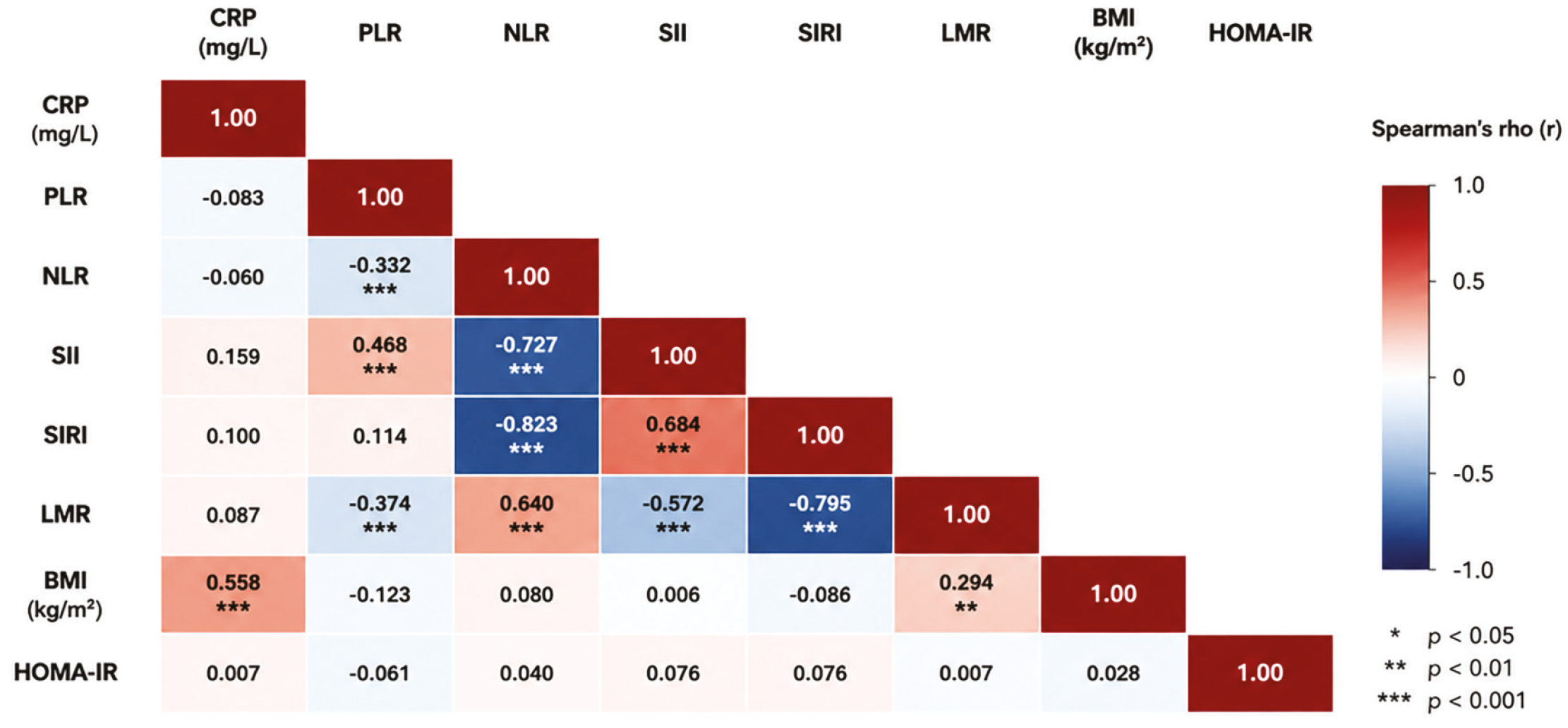
BMI: Body mass index, CRP: C-reactive protein, HOMA-IR: Homeostatic model assessment of insulin resistance, NLR: Neutrophil-to-lymphocyte ratio, PLR: Platelet-to-lymphocyte ratio, LMR: Lymphocyte-to-monocyte ratio, SII: Systemic immune-inflammation index, SIRI: Systemic inflammatory response index. The color scale represents the direction and magnitude of Spearman’s correlation coefficients (r)
Discussion
In the present study, neither metabolic parameters nor systemic inflammatory markers were associated with clinical pregnancy after the first IUI cycle following ovulation induction with an aromatase inhibitor. Multivariable analysis likewise identified no inflammatory marker as an independent predictor of pregnancy. CRP showed the strongest association, although it did not reach statistical significance, while correlation analysis demonstrated strong relationships among inflammatory indices, particularly SII and SIRI, and a positive correlation between CRP and BMI.
Chronic low-grade inflammation and metabolic dysfunction are well recognized in PCOS; however, their relevance to pregnancy outcomes after IUI remains insufficiently defined (-). Evidence on systemic inflammatory markers in IUI populations is limited and has largely been derived from heterogeneous cohorts including different infertility etiologies (, , ). Consequently, whether these markers have prognostic value specifically in women with PCOS undergoing IUI remains unclear. The present study was designed to address this gap by evaluating the association of systemic inflammatory and metabolic markers with clinical pregnancy after the first IUI cycle in a relatively homogeneous PCOS cohort.
Insulin resistance affects approximately 50-70% of women with PCOS, independent of obesity, and may contribute to both hyperandrogenism and impaired endometrial receptivity (-). Insulin resistance may impair implantation by altering endometrial receptivity-related pathways, including HOXA10, LIF, αvβ3 integrin–mediated adhesion, decidualization, and immune responses (). In the present study, HOMA-IR, fasting insulin, HbA1c, and BMI were evaluated as metabolic parameters, but none were significantly associated with clinical pregnancy. Visceral adiposity may contribute to chronic low-grade inflammation through altered cytokine, chemokine, and adipokine secretion, although inflammation in PCOS, particularly in non-obese women, cannot be explained by adiposity alone (, ). These findings suggest that the relationship between metabolic dysfunction, systemic inflammation, and reproductive outcomes may be more complex than can be captured by conventional circulating markers alone. The extent to which systemic inflammatory markers reflect the uterine immune microenvironment and influence implantation therefore remains uncertain.
Studies examining systemic inflammatory markers and pregnancy outcomes in ART have yielded inconsistent findings, and data in IUI populations remain limited. Li et al. () reported that higher SII was associated with poorer pregnancy and live birth outcomes in women undergoing gonadotropin-releasing hormone antagonist IVF, although women with PCOS were excluded. In contrast, Tulucu Kalkan et al. () found that NLR, PLR, MLR, SII, SIRI, and PIV did not independently predict clinical pregnancy in women with unexplained infertility undergoing IVF/intracytoplasmic sperm injection. These discrepancies suggest that the prognostic value of inflammatory markers may depend on infertility etiology, metabolic profile, and treatment protocol. Consistently, none of the inflammatory markers evaluated in our homogeneous PCOS cohort undergoing IUI following ovulation induction with an aromatase inhibitor were associated with clinical pregnancy in univariable or multivariable analyses.
SII and SIRI have emerged as systemic inflammatory indices with expanding clinical applications beyond oncology, although evidence in reproductive medicine remains limited (, , ). In our cohort, neither SII nor SIRI was associated with clinical pregnancy. Similarly, PLR and LMR, reflecting platelet-lymphocyte and lymphocyte-monocyte interactions, were not associated with pregnancy outcomes (, ).
CRP is a well-established marker of low-grade chronic inflammation in PCOS and has been associated with metabolic disturbances (). However, evidence regarding its relationship with fertility outcomes remains inconsistent. In a randomized IVF study of 440 women, Vexø et al. () found no association between CRP and clinical pregnancy, although higher CRP levels were negatively correlated with live birth. Similarly, CRP was not significantly associated with clinical pregnancy in our cohort, although it showed the strongest association among the evaluated inflammatory markers in multivariable analysis. Its positive correlation with BMI further supports the close relationship between metabolic status and systemic inflammation in PCOS.
The strong correlations observed among inflammatory indices suggest that these markers largely reflect overlapping components of systemic inflammation rather than distinct biological pathways. Given the multifactorial nature of implantation and clinical pregnancy, which are influenced by hormonal, metabolic, embryological, and uterine factors, systemic inflammatory markers alone may be insufficient to capture the complex mechanisms underlying reproductive outcomes in women with PCOS.
Strengths
• The study was based on five years of real-world clinical experience at a tertiary referral center.
• The relatively homogeneous study population, consisting exclusively of women with PCOS undergoing their first IUI cycle following ovulation induction with an aromatase inhibitor, reduced heterogeneity related to infertility etiology and prior treatment exposure.
• The study addresses a clinically relevant gap in the literature, as data on systemic inflammatory markers and IUI outcomes in women with PCOS remain limited.
• A broad range of demographic, metabolic, and systemic inflammatory parameters was evaluated, including newer inflammatory indices such as SII and SIRI.
Study Limitations
• The relatively small sample size and limited number of clinical pregnancies may have reduced the statistical power to detect more modest associations; therefore, the possibility of type II error cannot be excluded.
• Because of the limited number of clinical pregnancy events, infertility duration and additional metabolic variables were not included in the multivariable models; therefore, residual confounding cannot be completely excluded.
• The retrospective, single-center design may introduce selection bias and limit the generalizability of the findings.
• Assessment of systemic inflammatory markers at a single time point may not fully reflect the dynamic and local endometrial immune processes relevant to implantation. In addition, advanced inflammatory biomarkers and direct measures of endometrial receptivity were not available, and live birth outcomes were not evaluated.
Conclusion
In our study, systemic inflammatory markers were not significantly associated with clinical pregnancy in women with PCOS undergoing their first IUI cycle following ovulation induction with an aromatase inhibitor. Future larger prospective studies further evaluating this relationship, integrating systemic and local endometrial biomarkers, and assessing patients within the broader multisystem framework of PMOS may contribute to a better understanding of the mechanisms underlying implantation and improve the prediction of IUI outcomes.
Footnotes
Ethics
Ethics Committee Approval: Ethical approval for this study was obtained from the Clinical Research Ethics Committee of the Scientific Ethics Committee of Göztepe Prof. Dr. Süleyman Yalçın City Hospital (approval no: 2026/0297, date: 06.05.2026), and the study was conducted in accordance with the principles of the Declaration of Helsinki.
Informed Consent: The requirement for informed consent was waived by the ethics committee due to the retrospective nature of the study.
Authorship Contributions
Surgical and Medical Practices: N.H.D., N.A., M.A.İ., Concept: H.B.Ç., P.K., B.K., Design: N.H.D., B.K., B.K., Data Collection or Processing: H.B.Ç., M.A.İ., Analysis or Interpretation: H.B.Ç., N.A., Literature Search: N.A., M.A.İ., B.K., Writing: N.H.D., M.A.İ., A.T.
Conflict of Interest: No conflict of interest was declared by the authors.
Financial Disclosure: The authors declared that this study received no financial support.
References
Teede HJ, Misso ML, Costello MF, Dokras A, Laven J, Moran L, et al.; International PCOS Network. Recommendations from the international evidence-based guideline for the assessment and management of polycystic ovary syndrome. Fertil Steril. 2018;110(3):364-379.
Joham AE, Norman RJ, Stener-Victorin E, Legro RS, Franks S, Moran LJ, et al. Polycystic ovary syndrome. Lancet Diabetes Endocrinol. 2022;10(9):668-680. Erratum in: Lancet Diabetes Endocrinol. 2022;10(11):e11.
Bodur S, Dundar O, Kanat-Pektas M, Kinci MF, Tutuncu L. The effects of different therapeutic modalities on cardiovascular risk factors in women with polycystic ovary syndrome: a randomized controlled study. Taiwan J Obstet Gynecol. 2018;57(3):411-416.
Berni TR, Morgan CL, Rees DA. Rising incidence, health resource utilization, and costs of polycystic ovary syndrome in the United Kingdom. J Clin Endocrinol Metab. 2025;110(5):e1580-e1589.
Teede HJ, Khomami MB, Morman R, Laven JSE, Joham AE, Costello MF, et al.; Global Name Change Consortium. Polyendocrine metabolic ovarian syndrome, the new name for polycystic ovary syndrome: a multistep global consensus process. Lancet. 2026;407(10545):2329-2339.
Repaci A, Gambineri A, Pasquali R. The role of low-grade inflammation in the polycystic ovary syndrome. Mol Cell Endocrinol. 2011;335(1):30-41.
Rostamtabar M, Esmaeilzadeh S, Tourani M, Rahmani A, Baee M, Shirafkan F, et al. Pathophysiological roles of chronic low-grade inflammation mediators in polycystic ovary syndrome. J Cell Physiol. 2021;236(2):824-838.
Su P, Chen C, Sun Y. Physiopathology of polycystic ovary syndrome in endocrinology, metabolism and inflammation. J Ovarian Res. 2025;18(1):34.
Rudnicka E, Suchta K, Grymowicz M, Calik-Ksepka A, Smolarczyk K, Duszewska AM, et al. Chronic low-grade inflammation in pathogenesis of PCOS. Int J Mol Sci. 2021;22(7):3789.
Kurt DS, Ağaoğlu RT, Kıncı MF, Sırma T, Kurt A, Pay RE, et al. Diagnostic value and metabolic association of serum clusterin in women with polycystic ovary syndrome. Diagnostics (Basel). 2026;16(1):167.
Zahorec R. Ratio of neutrophil to lymphocyte counts--rapid and simple parameter of systemic inflammation and stress in critically ill. Bratisl Lek Listy. 2001;102(1):5-14. English, Slovak.
Smith RA, Bosonnet L, Ghaneh P, Sutton R, Evans J, Healey P, et al. The platelet-lymphocyte ratio improves the predictive value of serum CA19-9 levels in determining patient selection for staging laparoscopy in suspected periampullary cancer. Surgery. 2008;143(5):658-666.
Dotto-Vasquez G, Villacorta-Ampuero AK, Ulloque-Badaracco JR, Hernandez-Bustamante EA, Alarcón-Braga EA, Herrera-Añazco P, et al. Lymphocyte-to-monocyte ratio and clinical outcomes in cholangiocarcinoma: a systematic review and meta-analysis. Diagnostics (Basel). 2022;12(11):2655.
Hu B, Yang XR, Xu Y, Sun YF, Sun C, Guo W, et al. Systemic immune-inflammation index predicts prognosis of patients after curative resection for hepatocellular carcinoma. Clin Cancer Res. 2014;20(23):6212-6222.
Qi Q, Zhuang L, Shen Y, Geng Y, Yu S, Chen H, et al. A novel systemic inflammation response index (SIRI) for predicting the survival of patients with pancreatic cancer after chemotherapy. Cancer. 2016;122(14):2158-2167.
Islam MM, Satici MO, Eroglu SE. Unraveling the clinical significance and prognostic value of the neutrophil-to-lymphocyte ratio, platelet-to-lymphocyte ratio, systemic immune-inflammation index, systemic inflammation response index, and delta neutrophil index: an extensive literature review. Turk J Emerg Med. 2024;24(1):8-19.
Karaduman AB, Balcı MF, Uğur Özizmirliler EC, Özağaç B, Şanlı M, Bozgeyik MB, et al. Evaluation of the use of first- and third-trimester hemogram parameters in prediction of preterm labor. Perinatal Journal. 2024;32(3):239-245.
Aboeldalyl S, James C, Seyam E, Ibrahim EM, Shawki HE, Amer S. The role of chronic inflammation in polycystic ovarian syndrome-a systematic review and meta-analysis. Int J Mol Sci. 2021;22(5):2734.
Karakaş HE, Çakır Karakaş M, Kıncı MF, Ensari T. Evaluation of inflammation markers and pregnancy outcomes of patients undergoing intrauterin insemination (IUI) for unexplained infertility. The Journal of Gynecology-Obstetrics and Neonatology. 2024;21(3):218-226.
Starosta A, Gordon CE, Hornstein MD. Predictive factors for intrauterine insemination outcomes: a review. Fertil Res Pract. 2020;6(1):23.
21.Pekcan MK, Ozgu-Erdinc AS, Yilmaz N, Tokmak A, Engin-Ustun Y. Inflammatory markers in peripheral blood cells cannot predict intrauterine insemination outcome: a retrospective cohort study. J Hum Reprod Sci. 2021;14(1):11-15.
Gavrizi SZ, Arya S, Peck JD, Knudtson JF, Diamond MP, Wild RA, Hansen KR. High-sensitivity C-reactive protein levels and pregnancy outcomes in women with unexplained infertility after ovarian stimulation with intrauterine insemination in a multicenter trial. F S Rep. 2022;3(1):57-62.
Ehrmann DA. Polycystic ovary syndrome. N Engl J Med. 2005;352(12):1223-1236.
Cortón M, Botella-Carretero JI, Benguría A, Villuendas G, Zaballos A, San Millán JL, et al. Differential gene expression profile in omental adipose tissue in women with polycystic ovary syndrome. J Clin Endocrinol Metab. 2007;92(1):328-337.
Matsuyama S, Whiteside S, Li SY. Implantation and decidualization in PCOS: unraveling the complexities of pregnancy. Int J Mol Sci. 2024;25(2):1203.
Spritzer PM, Lecke SB, Satler F, Morsch DM. Adipose tissue dysfunction, adipokines, and low-grade chronic inflammation in polycystic ovary syndrome. Reproduction. 2015;149(5):R219-R227.
Li X, Luan T, Wei Y, Zhang J, Zhou L, Zhao C, et al. Association between the systemic immune-inflammation index and GnRH antagonist protocol IVF outcomes: a cohort study. Reprod Biomed Online. 2024;48(5):103776.
Tulucu Kalkan F, Atlihan U, Aykanat G, Ertan B, Acet F, Tavmergen Goker EN, et al. Predictive value of hematological parameters for IVF success: a retrospective analysis. Front Reprod Health. 2025;7:1746987.
Vexø LE, Stormlund S, Landersoe SK, Jørgensen HL, Humaidan P, Bergh C, et al. Low-grade inflammation is negatively associated with live birth in women undergoing IVF. Reprod Biomed Online. 2023;46(2):302-311.